English
 Chinese
Scan QRCode

For the first time at an auto show, I found so many foreigners, "said Fang Haoming, a reporter from China Arab TV stationed in China, as he looked at the crowd of people with different skin colors and speaking multiple languages at Chery Automobile's booth at the 2026 Beijing International Auto Show, expressing his emotions. Fang Haoming's feelings are quite genuine. According to a spokesperson from Chery, on the first day of the auto show alone, over 3000 overseas guests with different skin colors checked in at the Chery booth. They are not only interested in cars, but even the ink armored robots on the exhibition stage have attracted a large number of overseas audiences to stop and shoot.
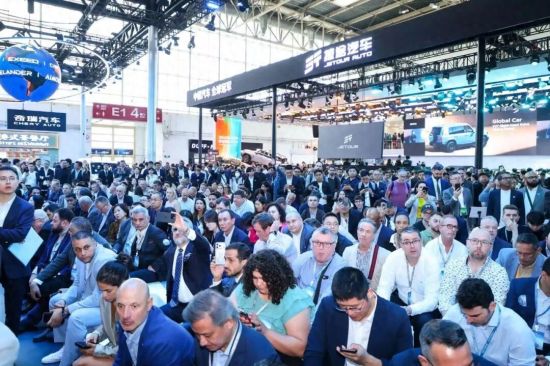
Photo source for Chery Automobile's 2026 Beijing International Auto Show press conference: Chery Automobile
This scene is a vivid footnote to the reversal of China's automotive industry status. Once upon a time, Chinese car companies were "pilgrims" at the Frankfurt and Munich car shows, looking up to new technologies from overseas brands with a learning heart; Nowadays, the industrial track is ushering in a crucial lane change, and the wave of electrification and intelligence is driving Chinese cars to complete a magnificent transformation from followers to leaders. The 2026 Beijing Auto Show will take this industrial pattern reversal to the extreme. The iPhone moment of Chinese automobiles may no longer be a distant prediction and speculation, but an industry reality that is currently landing, with a super large exhibition hall, thousands of exhibition cars, over a hundred global debut new cars breaking records, and a large number of overseas dealers and multinational media gathering at the scene.
Intelligence, from concept to inclusiveness
If China's automobile industry surpasses Japan in terms of export volume and has gained initial recognition from the international community in terms of scale, then intelligence is becoming an important lever for China's automobile industry to solidify its international status and truly achieve the transformation from large to strong. At this year's Beijing Auto Show, several car companies announced their commercial schedules and latest developments for the L3 function. Huawei officially released the Qiankun ADS 4.0 system at the auto show, claiming to achieve seamless intelligent driving capability from parking spot to parking spot. Xiaopeng Motors announced that its XNGP 5.0 system will launch a flagship model equipped with L3 hardware by the end of 2026.
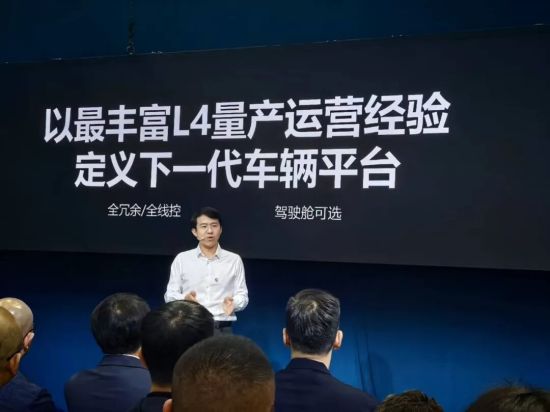
Carl Power Press Conference Live Photography/Liu Shanshan
KargoBot Inside, the core strategy for L4 freight transportation for the next decade, has been released by KargoBot. This is the world's first "AI+Robot+Service" full stack empowerment strategy for mainline freight transportation, marking the official transition of L4 autonomous driving freight transportation from technical verification to full dimensional implementation, and will drive L4 freight transportation into the "era of 10000 units" in the next three years. What is even more milestone is that a large number of foreign brands have begun to actively adapt and purchase Chinese intelligent driving solutions. Former technology exporters are now extending olive branches to Chinese companies: Volkswagen ID.ERA 9X and SAIC Audi E7X are both equipped with Momenta's intelligent driving solution, BMW's new generation iX3 and i3 long wheelbase versions are jointly developed with Momenta's intelligent driving system, and Mercedes Benz's domestically produced navigation assisted driving system is specially tailored for China's complex road environment.
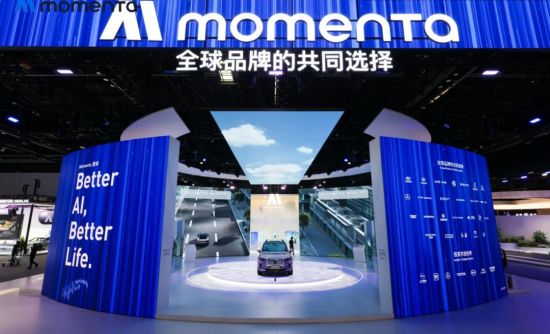
Photo source for Momenta booth at the 2026 Beijing International Auto Show: Momenta
Momenta CEO Cao Xudong told China Newsweek, "German BBA and Volkswagen, Japanese Toyota, Honda, Nissan, American General Motors, and Ford have all become our production partners. ”This cooperation is not simply about supply chain adaptation, but a comprehensive recognition of Chinese intelligent technology by foreign brands. Foreign car companies not only purchase Chinese technology, but also increase their local research and development in China. BMW has even established four major research and development centers in China to strengthen local intelligent technology research and development. BMW Group's director in charge of customer, brand, and sales operations, Gao Le, told China Newsweek, "China's digital ecosystem is difficult to replicate, and we must maintain strong competitiveness here." "The new generation BMW intelligent driving assistance system, which we jointly developed with Momenta, was first introduced as the new generation BMW iX3 long wheelbase version, followed by the all-new BMW 7 Series, new generation BMW i3 long wheelbase version, and subsequent models sold in China. ”Gao Le said, "This system can achieve L2 level intelligent driving assistance in both urban and highway sections, and allows the driver to intervene and control under specific conditions without the system exiting. This is what we consider intelligent. ”In the view of Zhang Yongwei, Chairman of Chebaihui Research Institute, integrated development has become mainstream. He stated at the 2nd Autonomous Driving Industry Development Forum: "In the past, the automotive industry and the semiconductor and communication industries were not very closely connected to each other. In the era of autonomous driving, AI, semiconductor, communication, and the automotive industry are deeply integrated, breaking the boundaries of the past industries. ”He said that the deep cooperation model between car companies and technology companies has achieved complementary advantages, promoted the rapid landing of technology, and the significant reduction in costs has further enabled intelligence to move from high-end models to universal. In the past two years, the overall cost of advanced self driving has decreased by 40% -60%. Intelligent driving, which used to be only available in high-end cars, can now be equipped in models priced at tens of thousands of yuan, greatly expanding the development space of intelligent driving. Cao Xudong predicts that the scale effect and first mover advantage of the intelligent driving industry are stronger than those of the chip industry, and the feature of zero software marginal cost means that the more data there is, the better the experience and the lower the cost. The cooperation period between the host manufacturers is extremely long - domestic car companies need 3 years, while overseas car companies need 5-7 years. He gave an example, Momenta partnered with Mercedes Benz in 2017 and only achieved its first mass production project by the end of 2025, which took 8 years. Therefore, the industry will quickly converge, with only 2-3 companies remaining in China and 3-4 companies globally, resulting in a highly concentrated pattern.
Intelligence drives Chinese cars to go global
The breakthrough in intelligent technology is transforming into the core competitiveness of Chinese automobiles in the global market. In the first quarter of 2026, China's automobile exports will continue to grow rapidly, becoming the biggest highlight of the automobile market. According to the China Association of Automobile Manufacturers, China exported 2.226 million vehicles in the first quarter, a year-on-year increase of 56.7%. The cumulative export of new energy vehicles was 954000 units, a year-on-year increase of 116.2%, accounting for 42.9% of total automobile exports, further increasing from 36.8% in 2025.
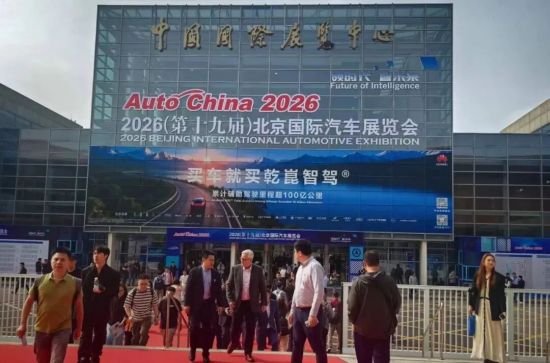
Live Photography at the 2026 Beijing International Auto Show by Liu Shanshan
It is worth noting that the globalization of Chinese automobiles is no longer just about exporting products, but has formed a new pattern of "Chinese research and development, global sales". In 2025, Nissan and Dongfeng established an export joint venture, with the original intention of promoting China's research and development of new energy vehicle models to the world. Nissan CEO Ivan Espinosa told China Newsweek that the N7 will be exported to Latin America and Southeast Asia, while the pickup truck model Frontier Pro will be exported to Latin America, Southeast Asia, and the Middle East, with plans to export the NX8 in the future. The core technology, development speed, and cost advantage we have achieved in the Chinese ecosystem of these products will also play an important role in overseas markets, "said Ivan Espinosa. Europeans are more focused on energy transformation, which is a major opportunity for China's new energy vehicles, "Lu Fang, Chairman and Party Secretary of Lantu Automotive Technology Co., Ltd., told China Newsweek." We adhere to the high-value route in overseas markets. As a state-owned enterprise, we should reflect the image of Made in China. We hope to establish our brand, improve user experience and service, and make more overseas users trust Chinese brands and products. "In terms of intelligent driving, Lantu has completed forward-looking layout and achieved 200000 kilometers of actual road testing. In March of this year, Lantu's L3 level intelligent architecture was the first to be mass-produced and implemented. In the future, Kunpeng Intelligent Driving will leap from integrated driving and parking to L3 level full scene assisted driving, with continuous iteration of the Xiaoyao cockpit to create a "third space" that understands users better. Going global is not just about exporting products, but about the comprehensive output of technology, products, services, and brand value. "Kang Bo, Vice President of Serys Group, proposed at the 2026 Intelligent Electric Vehicle Development Forum that Chinese brands can go global in three stages: the first stage is" going in ", establishing business foundations through trade cooperation; The second stage is to 'go up' and promote localized production and research and development; The third stage is to 'step out' and achieve global output of technical standards and brand value. Behind this all-round output is China's unique digital ecological advantage. China has a unique digital ecosystem, such as Alibaba and Tencent, which are difficult to replicate outside of China, "Gao Le said frankly." Young users in the Chinese market have a higher acceptance of digitalization, which also forces overseas car companies to accelerate localization cooperation. BMW's cooperation model in the Chinese market is quite representative: BMW controls the underlying technology, while digital content collaborates with local partners. For example, AI voice interaction uses the technologies of Alibaba and Deepseek. The App Store cooperates with Huawei and also works with ByteDance/Volcano Engine to create an AI enabled customer experience journey. This is a 'strong alliance', and we adopt a similar logic overseas, but our partners will adjust according to regional markets. "For example, in terms of voice, BMW will use Alexa+globally, and the new version of Alexa will first be launched in English and German in the United States and Europe." Ecological and technological partnerships are becoming increasingly regional rather than global. Of course, in the process of cooperation between Chinese suppliers and foreign car companies, they also face challenges of cultural differences and standard differences. According to Cao Xudong, the most common challenge is that there are sometimes contradictions and conflicts between China's speed and international OEM standards. But the core of this contradiction revolves around customer and user value. As long as we co create with the user as the center, we can often find better innovative methods and bring unexpected results. Cao Xudong proposed a solution of "reverse joint venture" to address the potential impact of Chinese technology going global. Chinese technology is moving towards the world, and the overall development speed is very fast, "said Cao Xudong. When Chinese technology enters other markets, it not only brings more leading product value to local users, but also has an impact on local companies, employment, or taxation. Reverse joint venture not only allows local areas to enjoy Chinese technology and products, but also empowers local enterprises to achieve win-win results. In Zhang Yongwei's view, the significance of autonomous driving goes far beyond the automotive industry itself, and it will greatly drive the coordinated development of multiple fields such as artificial intelligence and electronic communication. He emphasized that the global competition in autonomous driving is a dual competition, "both in terms of technology and regulatory level, and both lines must be won to ensure sustained industry leadership.
AMS2024 Exhibition Guide | Comprehensive Exhibition Guide, Don't Miss the Exciting Events Online and Offline
Notice on Holding the Rui'an Promotion Conference for the 2025 China (Rui'an) International Automobile and Motorcycle Parts Exhibition
On September 5th, we invite you to join us at the Wenzhou Auto Parts Exhibition on a journey to trace the origin of the Auto Parts City, as per the invitation from the purchaser!
Hot Booking | AAPEX 2024- Professional Exhibition Channel for Entering the North American Auto Parts Market
The wind is just right, Qianchuan Hui! Looking forward to working with you at the 2024 Wenzhou Auto Parts Exhibition and composing a new chapter!
Live up to Shaohua | Wenzhou Auto Parts Exhibition, these wonderful moments are worth remembering!
Free support line!
Email Support!
Working Days/Hours!



Copyright © 2018, PKT Auto Parts All Rights Reserved
浙ICP备18033565号-1
 浙公网安备33038102332475号